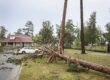

On Friday, June 19, 2026, a powerful hailstorm swept through a narrow but densely populated corridor of the Twin Cities metro, causing widespread roof damage and knocking out power to more than 20,000 Xcel Energy customers. If your home is in Roseville, northern or eastern St. Paul, Maplewood, North St. Paul, Woodbury, Shoreview, Fridley, Columbia Heights, or northeast Minneapolis, you are almost certainly in the impacted zone. Here is what you need to know about the June 2026 hail storm roof damage in Minneapolis and St. Paul — and exactly what to do this week.
What the June 19, 2026 Hailstorm Delivered
According to the National Weather Service Minneapolis, the June 19 event was one of the most significant hail storms to strike the Twin Cities corridor in recent years. A supercell that developed over eastern Wright County tracked southeast through the metro, dropping large hail along the I-94 and I-694 loop. Key details from the NWS storm summary:
- Hail size up to 2.25 inches: Significantly larger than golf ball size and large enough to crack asphalt shingles, damage metal roofing panels, shatter skylights, and destroy gutters in a single pass.
- Hail falling for over 10 minutes: Some areas in the affected corridor experienced continuous hail impact for more than 10 minutes — far longer than typical events, meaning roofs absorbed thousands of individual strikes.
- Wind gusts near 60 mph: A secondary line of storms followed the hail, bringing near-60-mph wind gusts that compounded damage to already-compromised roofing systems.
- Most affected neighborhoods: The I-94 to I-694 corridor was hit hardest. Northern St. Paul recorded 2-inch-plus hail. Roseville, Maplewood, Shoreview, Fridley, Columbia Heights, and northeast Minneapolis were all heavily impacted.
What 2.25-Inch Hail Does to an Asphalt Shingle Roof
Hailstones that large don’t simply bruise shingles — they crack them. At 2.25 inches, a hailstone carries enough kinetic energy to fracture asphalt shingles at the point of impact, compromise the fiberglass mat underneath, and create direct pathways for water intrusion that begin leaking in the next rain event. Even metal roofing panels can show visible denting from hail this size unless they carry a Class 4 impact resistance rating. For the asphalt shingle roofs throughout the affected corridor, full replacement — rather than repair — is the expected outcome for most homes that took a direct hit.
The 7-Day Window That Matters Most
The first week after a major hailstorm is the most critical for Twin Cities homeowners. Here is why acting now matters:
- More rain is coming: Any cracked shingles, lifted edges, or compromised flashings from June 19 become active leaks in the next rain event. Minneapolis averages one to two significant rain events per week in late June and July.
- Reputable contractors book up fast: After a storm of this scale, experienced roofing contractors fill their schedules within days. Waiting means longer delays — or working with out-of-town “storm chasers” who move on after the rush without honoring warranties.
- Documentation is time-sensitive: Insurance adjusters look for evidence of fresh storm damage. The longer you wait to have your roof inspected, the harder it becomes to tie the damage specifically to the June 19 event — rather than previous storms or age-related wear.
- Insurance reporting windows: While most Minnesota homeowner policies allow 12–24 months to file, earlier documentation creates a stronger, cleaner claim. Acting this week puts you in the best possible position.
How to Assess Your Home Right Now
Before calling a roofer, do a quick ground-level check around your property to gauge how hard your home was hit:
- Walk the perimeter and look in your gutters for dark granules — they look like coarse sand and are the clearest ground-level sign of shingle impact
- Inspect your AC condenser unit, window screens, and garage door trim for round dents — if soft metals are dented, your roof sustained hail impact of similar intensity
- Check downspouts by holding a white piece of paper at the outlet after the next rain — granule discharge will stain it black
- Use binoculars to scan the ridge line for missing cap shingles, cracked material, or displaced sections
- Go into the attic and look for any daylight, moisture, or water staining on the underside of the roof deck
Why June 19 Is the Moment to Consider Metal Roofing
If the June 19 hailstorm is prompting you to replace your roof, this is the right moment to consider upgrading to a Class 4 impact-resistant metal roofing system. Standing seam metal roofing — Northern Lights’ specialty — is engineered to handle exactly the conditions that swept through the Twin Cities on June 19. Class 4 impact-rated metal panels are tested against two-inch steel balls dropped at 90 mph, simulating the worst hail events Minnesota can produce, without cracking, denting, or losing structural integrity. Beyond storm performance, many insurance carriers offer 20–30% premium discounts for homes with Class 4 impact-resistant roofing installed. Over the lifetime of the roof, those savings — combined with a 40–70 year lifespan — often make metal the most cost-effective choice for Minnesota homeowners who have experienced one too many storm seasons.
Free Inspections Across the June 19 Storm Corridor
Northern Lights Metal Roofing is scheduling free roof inspections throughout the entire June 19 storm corridor — St. Paul, Roseville, Maplewood, North St. Paul, Woodbury, Shoreview, Fridley, Columbia Heights, and northeast Minneapolis. Our team will document all storm damage in writing, photograph every impacted area, and work directly with your insurance adjuster to ensure your claim accurately reflects what the June 19 hailstorm did to your home. Contact us today to get on the schedule before our availability fills — and before the next storm system arrives.