

Last weekend felt like July. St. Cloud and Minneapolis-St. Paul both hit 90°F on October 10, and more than 70 Minnesota climate stations set daily record highs over the three-day stretch. Then the wind swung to the northwest on the 12th, temperatures fell 15 to 20 degrees, and frost is in the forecast for Friday night. That whiplash is a good reminder that the roofing season has a clock on it. So, can you still get a roof installed? Yes, but cold weather roof installation follows different rules, and it pays to know them before you book.
Cold weather roof installation: what changes below 40°F
Temperature affects asphalt shingles more than any other roofing material. Two things happen as it gets colder. First, the shingles stiffen and can crack when bent around hips, ridges, and valleys. Second, the self-sealing adhesive strip on each shingle will not activate without warmth and sunlight. Manufacturers generally recommend installation when temperatures are above 40°F and rising, and they provide specific cold-weather procedures when it is not.
None of this means a November roof is a bad roof. It means the crew has to work differently, and the homeowner should understand what will happen in the spring.
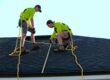
How a good crew handles cold weather roof installation with asphalt shingles
- Shingles stay in a heated trailer or garage until the moment they go on the roof.
- Crews hand-seal every shingle with a bead of roofing cement under each tab, because the factory strip may not bond until spring.
- Crews adjust nail guns so they do not overdrive brittle shingles.
- Crews cut and place starter strips and ridge caps, which bend the most, with extra care.
- Work stops when there is frost or snow on the deck. Nothing adheres to ice.
We follow the published cold-weather guidance from GAF as a GAF Master Elite® Residential Contractor, which you can review at gaf.com. The guidance exists precisely because roofers do install in cold climates, and the warranty remains valid when crews follow the procedures.
Metal roofing is far less sensitive to cold
Standing seam metal panels have no adhesive seal to activate. They attach with concealed clips and interlock mechanically, so a cold-weather installation performs exactly like a July one. The practical limits are safety and moisture, not the material. Crews cannot work on an icy deck, and underlayment should go down on dry sheathing. Otherwise, metal projects run well into late fall. That is one reason metal roofing is popular with homeowners who discover storm damage in October.
What about the seal strip: will my shingles blow off?
This is the question we hear most. A hand-sealed shingle roof is secure through the winter. The roofing cement bonds the tabs immediately, and the factory strip adds a second bond once warm weather returns. The roofs that lose shingles in March are the ones where a crew skipped hand-sealing to save time. Ask any roofer quoting a late-season job to put hand-sealing in writing.
Cold weather roof installation and your insurance claim
If summer hail damaged your roof and your insurer approved the claim, waiting until spring usually works against you. Granule loss accelerates through freeze-thaw cycles, and a damaged roof invites ice dams. Most policies also expect repairs to proceed within a reasonable time after the loss. Our storm damage restoration team can usually complete an approved claim before the snow flies, and we hand-seal every late-season shingle roof as standard practice.
Is it ever too cold to roof?
Yes. Once daytime highs stay below freezing and snow is on the roof, shingle work stops for the season except for emergency repairs. Metal can continue a bit longer on dry days. In a typical year, that means asphalt projects wrap up by late November across the Twin Cities and the Chippewa Valley, and a week or two earlier north of St. Cloud. This year’s warm autumn has stretched the window, but the frost forecast this week is the first real signal that it is closing.
Book before the window closes
Northern Lights Metal Roofing installs metal and asphalt roofs across Minnesota and western Wisconsin, and our crews are trained in cold-weather procedures for both. If you need a roof before winter, contact us this week for a free inspection and a firm installation date. Call (763) 276-1390 in Minnesota or (715) 501-7663 in Wisconsin. For the case for scheduling in autumn, see our post on the best time to replace a roof.